The Two Questions That Decide Your Structure
Every payout model is an answer to two questions. What are you actually buying, and who absorbs the downside if the content flops?
You are buying one of three things. The asset itself, which is a file you own and can run anywhere. Attention, which is views on the creator's own account. Or sales, which is attributed revenue.
Risk follows the same split. Flat fees put the risk on you. Pure performance deals put it on the creator. Everything else in this guide is a negotiated point between those two poles.
Get these two answers straight before you look at a single number. Most bad creator programs are not priced wrong. They are structured to reward the wrong thing.
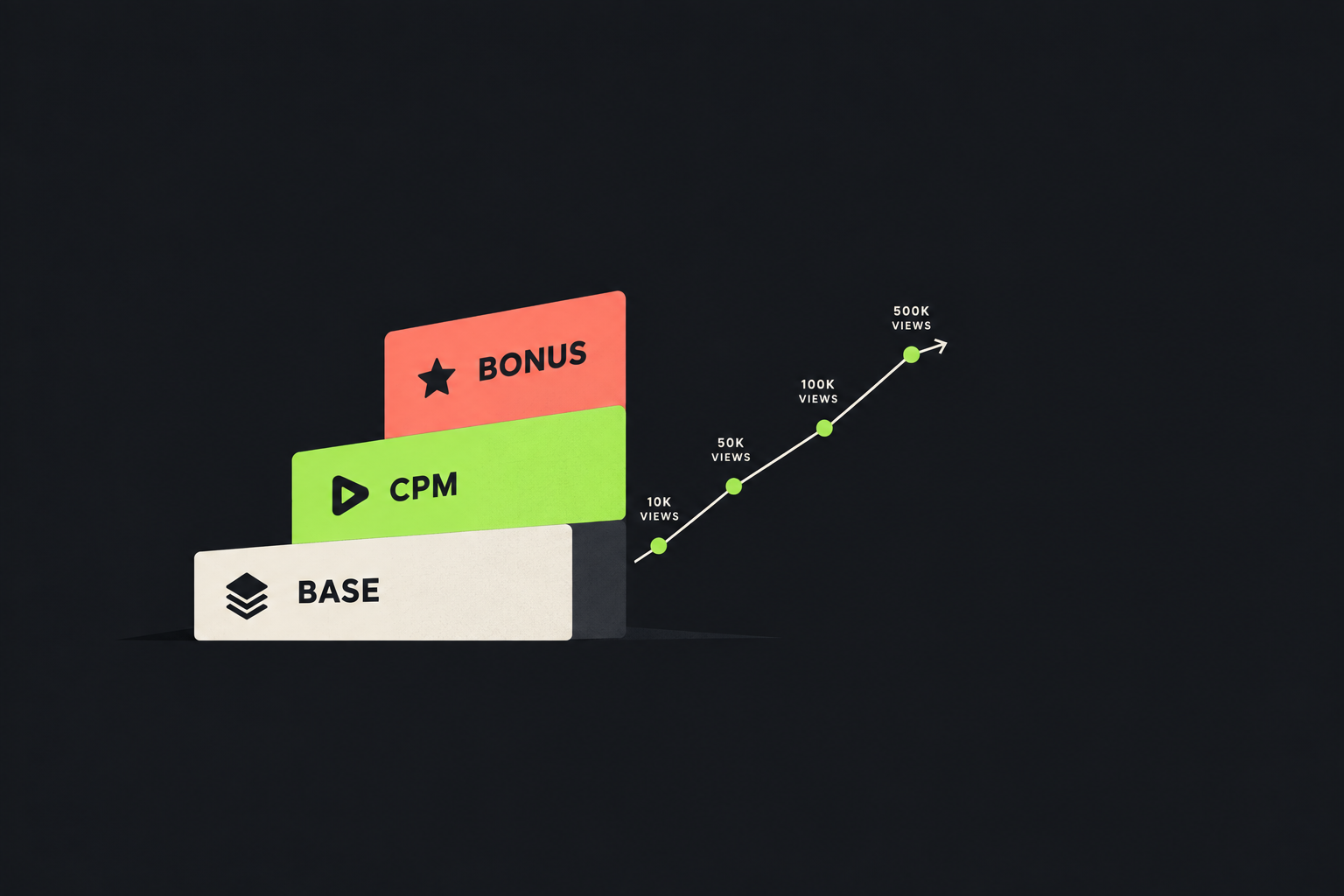
Base Plus CPM: The Default Organic Structure
This is the workhorse, and it is how we pay our own internal creators at Roster. A guaranteed monthly base of $600 to $800, plus a CPM on top, meaning a rate paid per thousand views.
The base usually climbs as a creator stays in the program. Someone six months in is faster, needs less briefing, and already knows what converts for the brand. Paying them the intake rate is how you lose them.
On the large programs we have raised real budget for, the headline CPM is $1. In practice the all-in effective rate lands closer to $2 to $3 once bonuses and the base are blended back in. That gap matters. Brands who quote themselves the headline number consistently underbudget.
The structure works because it covers the floor and rewards the ceiling. The creator can pay rent on the base. The brand pays the real money only when the content travels.
For a wider view of what creators charge across formats, the 2026 UGC rates breakdown is a useful companion to this section.
What the market pays around this model
Published rates cluster tightly. One documented structure pays $300 to $500 a month against $1 to $2 per thousand views at a cadence of ten to fifteen videos a week. Programs built on dedicated brand accounts rather than creator audiences run a per-video base of $20 to $40 with a view-bonus ladder at roughly a $3 to $5 CPM.
The benchmark worth anchoring on is cost per view at scale. The C4 Energy drive-to-retail program posted a blended $1.62 CPM across more than 80 million organic views. That is the number to beat, and it is achievable only with volume.
Half Base, Double CPM: More Upside, Real Risk
The obvious next move is to cut the base in half and double the CPM. It is an excellent structure. It is also the one that quietly destroys margin.
Here is the trap. A doubled CPM is a bet that your revenue per view justifies it. If you do not know your conversion rate and your revenue-per-view ratio, you are writing a blank cheque. Creators make a great deal of money on the upside. You may not.
Run this structure only when three things are true. You have attribution you trust. You know what a thousand views is worth in revenue. You have enough historical volume that the number is stable rather than a lucky month.
If all three hold, a lower base with a much higher CPM is the most capital-efficient organic structure available. If any one of them is missing, stay on the standard split until it is not.
The Graduation: Flat Retainers for Proven Performers
Once a creator has proven they perform repeatedly, the economics invert. You stop paying for upside because the upside is now predictable.
At that point the move is a much higher flat retainer, in the range of $5,000 to $10,000 a month, with the CPM cut entirely. The creator trades variance for certainty. You trade a higher fixed cost for a known, reliable output from a known, reliable performer.
This is a retention tool as much as a pay structure. A proven creator with a track record is being approached by other brands constantly. A flat retainer at that level is usually what keeps them.
The trigger to graduate someone is consistency, not a single hit. One viral video is luck. Six months of above-median performance is a skill you should lock in.
View Milestone Bonuses: The Layer on Top of Everything
Bonuses are not a separate model. They are a layer that sits on top of whichever structure you picked, and almost every serious program runs them.
The standard ladder pays out at 100,000, 200,000, 500,000, and 1,000,000 views. Each step is a discrete payment on top of the base and the CPM.
The reason this works is distributional, not motivational. Organic reach is brutally top-heavy. In one documented program only about 1.2% of posts crossed ten thousand views, and the top 1% of posts drove roughly 88% of total views.
A flat CPM pays the same rate for the long tail as for the outliers. Milestone bonuses concentrate money on the few posts that actually move the business. Set the ladder where your own distribution curve bends.
Click and Link Tracking: Paying for Traffic, Not Attention
Views are a proxy. Clicks are closer to the thing you want.
The structure is simple. Give each creator a tracked link or a dedicated landing page in their bio, then attach bonuses to click volume rather than view volume. It runs alongside a base in exactly the way a view bonus does.
This is worth doing when your product needs consideration rather than impulse. A high-ticket item rarely converts off a single video. Tracked clicks tell you which creator is actually sending qualified traffic, which views alone will never show you.
The practical warning is attribution hygiene. One link per creator, one destination, no shared codes. Shared codes make the data worthless within a month.
Paid Ads: Percentage of Spend and Percentage of Sales
Organic and paid are different businesses, and they price differently.
When creator content becomes an ad, the common structure is a percentage of ad spend, usually around 2%. On content that performs genuinely well the negotiated band sits at roughly 1% to 2%. The arithmetic is plain. A $10,000 media budget at a 10% share pays the creator $1,000, which is why the rate on spend-share deals is normally a low single digit.
The alternative is a percentage of attributed sales, often called GMV share. Published benchmarks put average creator commission near 13% of GMV, against a TikTok Shop platform commission of 9% in the United States. That channel is not a sideshow. Affiliate content drives roughly 42% of US TikTok Shop GMV.
The difference is where the risk sits. Spend share tracks your input, so you carry the performance risk. Sales share tracks output, so the creator carries it. Pick deliberately.
A disciplined sequence solves most of this. Test content organically first. Put media budget only behind the posts that already pulled. You then never owe a spend-share cut on a video that would have failed anyway.
Usage Rights and Whitelisting: The Layer Brands Forget
This is the line item that wrecks budgets, because it is priced separately from everything above and it is rarely quoted upfront.
Running creator content as a paid ad requires whitelisting. Those rights commonly add 20% to 50% on top of the creator's standard post rate. Broader content licensing runs wider still, from 20% to 100% above the base fee depending on duration and exclusivity.
Some creators price boosting as a share of spend instead, typically 5% to 20% of the paid budget behind the content. Exclusivity, meaning locking competitors out, is usually another 20% to 100% of the base rate.
Negotiate the total cost per dollar of spend, not the headline rate. Base plus share plus rights is the real number. Lock the rights into the first contract, because pricing power moves to the creator the moment the asset is already shot.
How to Pay UGC Creators Without Conversion Data
If you are starting cold with no attribution history, the sequencing matters more than the rate.
Start on the standard base plus CPM. Keep the base at the market floor and the CPM conservative. You are buying data, not reach.
Layer milestone bonuses immediately. They cost nothing until something works, and they tell you where your distribution curve actually bends.
Run that for one full quarter before changing anything. Then you will know your revenue per thousand views. Only then should you consider cutting the base and raising the CPM.
Graduate your top performers to retainers as they prove out. Move everyone else onto the performance-weighted structure. For the wider strategic frame, our guide to an organic UGC content strategy that drives revenue covers how this fits a full program.
Other Structures You Will Meet
Not every deal fits the models above. These show up regularly.
- Flat per-video fee. You buy the asset and nothing scales. Typical published bands run $50 to $150 for beginners, $150 to $350 for intermediate creators, and $350 to $500 for experienced ones. Payment convention is half upfront, half on approved delivery.
- Per-view pool. A fixed budget split proportionally among creators by measured views. Your cost is capped, which is the entire appeal, but individual payouts are unpredictable.
- Gifting plus commission. Product in exchange for content, with affiliate upside. It scales cheaply and attracts a weaker creator pool. Useful for volume seeding, poor for your hero assets.
- Platform creator funds as a floor. TikTok's Creator Rewards pays roughly $0.40 to $1.00 per thousand qualified views. Treat it as background income for the creator, never as a substitute for paying them.
- Hybrid base plus commission plus bonus. The kitchen sink. Common in longer ambassador deals where a brand wants the creator invested across attention and sales at once.
If you are weighing this against an agency, the cost comparison between creators and agency production is the clearest breakdown of the delta.
Side by Side
| Structure | Pay tied to | Who carries risk | Use when |
|---|---|---|---|
| Flat per video | Delivery only | Brand | You need the asset, not reach |
| Base plus CPM | Floor plus views | Shared | Default for organic programs |
| Low base, high CPM | Mostly views | Mostly creator | You know revenue per view |
| Flat retainer | Nothing variable | Brand | Creator is proven and consistent |
| Milestone bonuses | View thresholds | Creator | Always, as an added layer |
| Click bonuses | Tracked traffic | Creator | Considered purchases |
| Percentage of ad spend | Your media budget | Brand | Rewarding ad-worthy creative |
| GMV or sales share | Attributed revenue | Creator | Attribution you trust |
Where This Is Heading
The direction is clear, and it is toward performance. The best programs are steadily shrinking the guaranteed portion and widening the variable portion. The end state many of us are building toward has no base at all for established creators.
Two forces are pushing it. Measurement got good enough that paying for output rather than effort is now practical. And money concentrated: the top 10% of creators captured 62% of creator payments in 2025, up from 53% two years earlier.
There is a counterweight worth respecting. A base is how you access creators who are not yet proven, and unproven creators are where your next top performer comes from. Cut the base to zero across the board and your pipeline dries up.
The sane position is a split program. Performance-weighted deals for proven creators, a guaranteed floor for new ones, and a clear graduation path between them.
Context on budget scale: for DTC brands running active programs, creator spend typically runs 2% to 3% of total revenue, reaching 3% to 5% in beauty and supplements. US creator ad spending was estimated at $37 billion in 2025, up 26% year over year.
FAQ
What is a normal CPM to pay a UGC creator?
For organic creator content, $1 per thousand views is a common headline rate on large programs. The all-in effective rate lands nearer $2 to $3 once base pay and bonuses blend in. Programs built on dedicated brand accounts often run a higher ladder, roughly $3 to $5 per thousand views, because there is no base audience doing the work.
Should I pay a base or go purely performance based?
Pay a base until you know your revenue per thousand views. A base is the price of buying reliable data and access to unproven creators. Once attribution is solid and a creator has a track record, shifting weight onto the CPM is both cheaper and better aligned.
How much should a view milestone bonus be?
Set the ladder at 100,000, 200,000, 500,000, and 1,000,000 views, then size each payment against your own distribution. The top 1% of posts can drive around 88% of total views. Bonuses concentrated at the high end usually buy more than a higher flat CPM across every post.
What percentage of ad spend do creators get?
Around 2% is the common structure for creator content running as paid media, with roughly 1% to 2% negotiated on strong performers. Creators who price boosting separately often ask 5% to 20% of the spend behind their content, so confirm which basis you are agreeing to.
Do usage rights cost extra on top of the creator fee?
Yes, and this is the most commonly missed line item. Whitelisting typically adds 20% to 50% over the standard post rate, and broader licensing runs 20% to 100% above the base fee depending on duration and exclusivity. Negotiate these into the first contract rather than mid-campaign.
When should a creator move to a flat retainer?
When performance becomes predictable rather than occasional. A single viral post is not the signal. Roughly six months of consistent above-median results is, and a retainer of $5,000 to $10,000 a month with the CPM removed is the usual shape of that graduation.