Eight Sleep creator marketing is worth studying because the brand puts its entire proof stack in public. Its homepage leads with the Pod 6 at a starting price of $1,999, a 4.5 rating based on 30,000+ reviews, named member quotes, and screenshots of X posts from customers (eightsleep.com, checked 2026-09-24). You can see the argument being built, layer by layer.
This teardown covers what the page actually shows, how the proof is sequenced, which creator formats map to a temperature-controlled bed or a cooling sheet set, and how to rebuild the same structure on a budget that is not Eight Sleep's.
Why Eight Sleep Creator Marketing Is Worth Tearing Down
Most bedding teardowns pick a brand with one low-priced SKU. Eight Sleep is the harder case, and the more instructive one. The Pod 6 starts at $1,999 according to Eight Sleep's own homepage (eightsleep.com, checked 2026-09-24), which means the creative has to survive a long deliberation window, a partner veto, and a spouse asking what a bed needs an app for.
That is the same structural problem you have at a lower price point, just amplified. A high-ticket sleep purchase involves two people, a delivery logistics question, and a mental comparison against the mattress already in the room. Creative that only shows a pretty bedroom loses on all three.
The second reason: Eight Sleep sells a product you cannot photograph. The homepage describes a Cover with built-in biometric sensors, a Hub that fits under most bed frames, and an app that sets temperature and syncs fitness data (eightsleep.com, checked 2026-09-24). None of that is visually obvious. Neither is the cooling fibre in your sheets or the density of your pillow foam. Both categories have to dramatize an invisible benefit through behaviour, not through product beauty shots.
A concrete version of the problem: a DTC cooling-sheet brand runs three ad concepts, all of them a slow pan across a made bed in morning light. Every competitor's feed looks the same. The fix is not better lighting. It is filming the 2am moment the product exists to solve, with a real person in an unmade bed, which is exactly the footage a studio shoot never produces. If you are deciding how many of these assets to commission, How Many Ad Creatives Does a Bedding Brand Need Monthly? has a working formula for the category.
What the Pod 6 Page Actually Shows
Read the page as a creative brief and the structure becomes obvious.
The product is explained in three named parts, Cover, Hub, and App, with a short function line for each (eightsleep.com, checked 2026-09-24). That is a script skeleton. Any creator can narrate three parts in thirty seconds without a script writer.
The benefits are written as scenarios, not specs. Eight Sleep's homepage frames couples fighting over the thermostat, training recovery, naps, travel, and snoring detection paired with a Base add-on (eightsleep.com, checked 2026-09-24). Each of those is a scene with a beginning and an end. Compare that to the average bedding PDP, which lists GSM and weave type and asks the customer to imagine the rest.
The specifics are numeric and narrow. The page states the Pod cools or heats each side from 55F to 110F, and that new Solo sizes cover Twin and Twin XL or one side of a Queen, King, or Cali King (eightsleep.com, checked 2026-09-24). A number that precise is easy for a creator to repeat and hard for a viewer to dismiss as marketing language.
Your takeaway: before you brief a single creator, write down the named parts of your product and the scenarios it shows up in. If you cannot fill either list, the creative problem is upstream of the creator. Our UGC brief generator is a faster way to get that structure onto paper than another deck.
The Proof Stack: Science, Experts, and Member Voices
Eight Sleep layers four different kinds of proof on one page, and the layering is the lesson.
First, in-house research. The homepage says an internal research team with over 12 PhDs and sleep scientists has run over 50 clinical studies on the Pod, and it links out to individual studies (eightsleep.com, checked 2026-09-24). Second, borrowed authority: the page names Andrew Huberman and Matthew Walker on a scientific advisory board (eightsleep.com, checked 2026-09-24). Third, volume: a 4.5 rating based on 30,000+ reviews, and the line "over one million nights of sleep improved" (eightsleep.com, checked 2026-09-24). Fourth, unpolished peer voices, including a July 10, 2023 post from Mark Zuckerberg about dialling in his sleep, and a run of short customer posts from members (eightsleep.com, checked 2026-09-24).
Notice the asymmetry. The clinical claims sit on the brand's own asterisked footnotes. The emotional claims sit in customer voices. That split is the part you should copy, because it keeps every measurable claim with the party that can document it.
For a bedding brand without a research team, the practical translation is simple. Creators describe sensation and behaviour. The brand owns any measurable claim, and the brand ties it to its own certification or test. "I stopped kicking the duvet off at 3am" is a creator line. "Rated to X cooling performance" is a brand line with a document behind it. Put that division in the brief so a creator never has to guess. How UGC Briefs Work for Brands (And How to Read One) walks through exactly how to structure that split on paper.
A workable version for a cooling-sheet brand: the creator says the fabric feels cool on contact and that she stopped waking up sweaty, the on-screen caption cites the brand's own certification, and the voiceover never mentions night sweats as a medical condition. One asset, two claim owners, no compliance rewrite.
Creator Angles That Fit a Smart Mattress
Seven formats that map cleanly to sleep products, in rough order of how often they survive a testing cycle.
The 2am Problem Scene
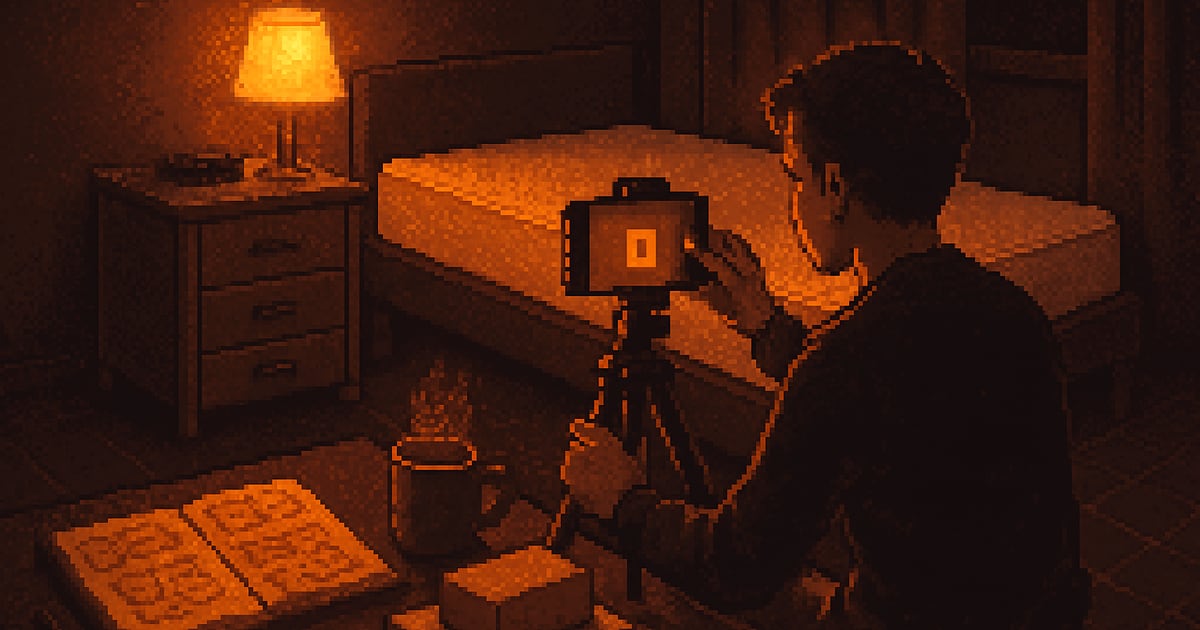
Open in the dark on an unmade bed, phone light only, person awake and frustrated. Cut to the fix. Eight Sleep's homepage sells the thermostat argument as a scenario rather than a feature (eightsleep.com, checked 2026-09-24), and the same scene works for a cooling pillow that costs far less. Shoot it handheld. Polish kills it.
The Partner Split Screen
Two sleepers, two preferences, one bed. This angle resolves the objection the buying partner raises, which is why it tends to hold up in testing. Film both people in one take, same frame, no cutaway.
Setup and Unboxing, Filmed Honestly
High-ticket sleep products get returned when setup surprises people. Have the creator film the actual box arriving, the actual weight, and the actual time it takes. For a mattress brand, that means the expansion window. Eight Sleep's page notes the Hub fits under most bed frames (eightsleep.com, checked 2026-09-24), which is a fit question a creator can answer on camera better than any diagram.
The 30-Night Check-In
Book the follow-up in the original contract. A creator who filmed the unboxing returns a month later and says what changed and what did not. This is your retargeting asset and your returns-reduction asset in one shot.
The App or Feature Walkthrough
Screen recording plus voice. Works for any sleep product with a tech layer, and works for non-tech products too if you reframe it as a care walkthrough (wash cycle, drying, how the fabric behaves after repeated washes).
The Skeptic Conversion
Creator states the objection up front: too expensive, too gimmicky, do not need it. Then answers it in their own words. Eight Sleep's page effectively runs this format through short customer posts calling it the best purchase they made (eightsleep.com, checked 2026-09-24).
The Routine, Not the Product
A full wind-down sequence where the product appears twice and never gets a hero shot. Lowest sales intent, best hold rate, useful for top-of-funnel prospecting.
Shoot list to attach to every bedding brief: one 2700K bedside lamp, no overhead light, camera at mattress height, bedding unmade, at least one shot with the sleeper's face out of frame, and one clip filmed in true low light so the footage looks like night instead of a lamp-lit set. White bedding clips highlights fast, so expose for the fabric and let the lamp blow out.
Building the Same Playbook at Your Budget
You will not staff a research team of PhDs. You can copy the sequence.
Step one: write the claim ledger. Two columns. Left column, everything a creator may say from personal experience. Right column, everything only the brand may state, each line tied to a certification, a lab result, or a dated third-party source. Anything that fits in neither column gets cut before briefing.
Step two: source creators who actually sleep in a bedroom you would film. This category has a hard production constraint that skincare does not. You need a bedroom with controllable light, a bed frame that fits your product, and in many cases a partner willing to appear. Screen for all three before you ship an expensive unit. Creators on UGC Roster pitch brands directly, so the applicants who reach you have already self-selected for motivation and category fit.
Step three: price the deal properly. A bedding shoot involves overnight filming across multiple days, which is not a one-hour content session. Run the number through the UGC rate calculator before you make an offer, and model the full test cycle in the UGC budget calculator so gifting cost, shipping, and usage rights are in the same line item. For a comparison of what agencies charge versus what independent creators cost in this category, UGC Creators vs Agency Ad Content: Real Cost Breakdown breaks down the economics.
Step four: brief for moments, not features. Give each creator one scenario from the list above and one product part to name. Do not send a feature list and hope. Build the brief in the brief generator so the claim ledger travels with the deliverable.
Step five: license for whitelisting up front. Partner ads on a creator's handle are worth testing against brand-handle placements in this category, and you should not have to renegotiate to run them. Get the handle access and the usage window in the first contract.
Step six: stage the proof. New customer sees a scenario ad. Mid-funnel sees the setup and the honest 30-night check-in. Bottom of funnel sees review volume and specifics. That is Eight Sleep's page order translated into an account structure.
Common Mistakes
Filming a made bed in daylight. Creators default to it because it looks clean and it is easy to light. It also looks identical to every competitor and to the stock footage in your PDP. Brief the unmade bed and the lamp instead, and say so in writing.
Repeating the brand's clinical claims in creator dialogue. Creators pull lines straight off the PDP because they think it sounds credible. It hands a regulated claim to an untrained endorser, and it stays the brand's problem. Give creators sensation language and keep measurable claims in captions the brand controls.
Skipping the setup footage on high-ticket units. It feels like boring content, so it gets cut in editing. Setup surprises drive returns in a category with a long trial window. Keep at least one asset that shows the box, the weight, and the real time to install.
Casting one sleeper for a two-sleeper product. Solo creators are easier to book and cheaper. They cannot film the objection that actually blocks the purchase, which is the partner disagreeing. Cast at least one couple per quarter, and pay for the second person's time.
Treating the bedroom as a set. Creators tidy aggressively before filming, and the room ends up looking like a hotel. Viewers read that as an ad instantly. Ask for a visible charging cable, a real water glass, and unstyled pillows.
Buying one-off content instead of a relationship. Brands book a single delivery because it is a smaller invoice. Then the 30-night follow-up never exists, and the most persuasive asset in the category is unavailable. Contract the follow-up at the start.
Overpromising comfort in the hook. "You will never be hot again" gets the click and earns the return. In a category with a trial window, an honest hook is a margin decision, not a brand-voice decision. Test a hook that names who the product is not for.
Next Steps
Do the claim ledger first, today, before any sourcing. Two columns, one sitting, and it will kill a good share of the creative ideas already in your backlog. That is the point.
Then pick one scenario from the creator angles list, not four. I would start with the partner split screen, because it answers the objection that stalls the purchase. Brief three creators on that single scenario using the UGC brief generator, price the deal with the rate calculator, and put the 30-night follow-up in the contract before anything ships.
When you are ready to source, post a brief creators can pitch against.
Sources
- Eight Sleep homepage, Pod 6, checked 2026-09-24
FAQ
What is bedding UGC?
Bedding UGC is creator-shot video or photo of sheets, pillows, mattresses or sleep tech, filmed in a real bedroom by the person sleeping on it and licensed for your paid ads. The difference from studio product photography is behaviour, not resolution. Someone kicking a duvet off at 2am is bedding UGC. A styled flat lay is not. Example: instead of a slow pan across a made bed, you get a creator holding a phone up to a sweat-damp pillowcase, then cutting to your cooling case the next morning. That contrast is the asset a studio day never produces.
How do you brief UGC creators for bedding and sleep ads?
Brief the moment, not the product. Name the time of day, the sleep state, who is in frame, and the first line spoken. A usable line reads: "Film at 2am, phone light only, unmade bed, start with why you woke up." Then add a do-not-say list, because sleep claims drift into medical territory fast. No curing insomnia, no apnea, no diagnosis language. Specify sleepwear coverage so the asset clears Meta review. Give the creator two weeks with the product before filming, since night-one and night-fourteen sound different. Include the usage window and whitelisting terms in the same document.
What should a bedding UGC shoot list include?
Seven clips, all shot on a phone, all in the creator's own bedroom.
- The problem moment, filmed at night with no styling.
- Unboxing, including how heavy the box is.
- A close macro of fabric, zipper, or seam.
- The partner scene, two people disagreeing about temperature.
- Morning-after reaction, filmed before makeup and coffee.
- A care detail, like the wash label or the fitted-sheet corner.
- Three CTA reads with different endings.
Cut clip one into multiple hooks, and reuse clip five as a standalone retention ad. Ask for raw files, not edited exports.
How do you find UGC creators who can actually film a bedroom?
Screen the room before you screen the reel. Ask every applicant for a ten-second unedited phone clip of their real bedroom, shot at night. A lot of applicants will not have one, and that is the point of asking early. What you want is one window, space to stand back from the bed, and a wall that is not a rental beige void. On UGC Roster's brand side, you source from a pool of 50,000+ vetted UGC creators, and 300+ brands hire through it. Of the 7,942 creators who have applied to a brand campaign, 343 have been hired, 4.3% (Roster hiring data, verified 2026-09-23), because each campaign books a handful regardless of how strong the rest of the field is.
How much does UGC cost for a bedding brand?
Budget for two line items, the content fee and the product you give away. Published category rates vary a lot. Influee lists creator rates of $22 to $67 per video with UGC videos starting at $81 (influee.co, checked 2026-08-22). soona lists $39 per photo and $93 per video clip, with a $149 studio booking for non-members (soona.co, checked 2026-08-22). minisocial lists managed projects starting at $3,000 for ten creators (minisocial.com, checked 2026-08-22). Platform access is separate: UGC Roster brand plans start at $379/month for Launch. For a mattress, the gifted unit usually dwarfs all of it.
Which UGC formats sell mattresses and bedding best?
Four formats carry the category. The night-one reaction, filmed the evening the product arrives, gives you an unrehearsed hook. The partner-conflict scene works because bedding is a two-person purchase and the objection lives in the other side of the bed. The check-in diary, filmed after a few weeks of sleeping on it, handles the trial-window question buyers are really asking. The objection ad is the one most brands skip: a creator saying out loud what almost stopped them buying, then answering it. Example: "I thought it would sleep hot in summer," followed by a July clip. Test all four before testing new hooks.
How many ad concepts should a bedding brand test at once?
Fewer than you think, and each one funded properly. The limiter is not creative volume, it is whether a concept collects enough purchase data before you judge it. Take your daily budget, divide by your target cost per purchase, and that tells you how many distinct concepts the account can actually read in a week. A brand spending modestly on a high-ticket product can support very few. If some concepts are starved and the rest are guesses, kill the guesses and put the spend behind the ones with data. Then iterate hooks inside the winner instead of launching another unrelated angle.
Related Reading
- UGC Brief Generator
- UGC Rate Calculator
- UGC ROI Calculator
- Content Mastery (free UGC course track)
- How Brooklinen Uses UGC and Creator Video in Its Ads